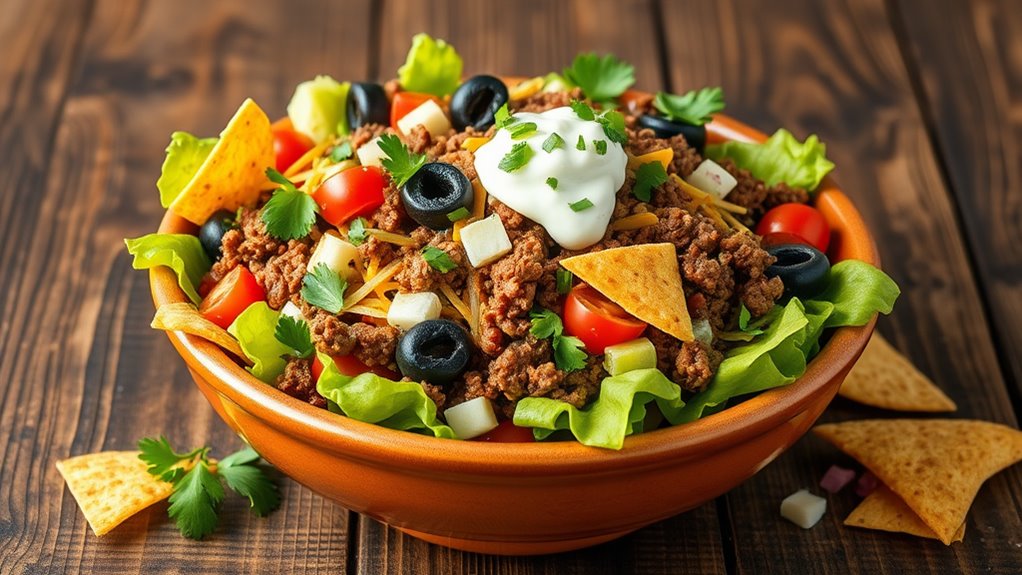
When crafting the perfect taco salad with seasoned ground beef, start with a flavorful blend of spices, then simmer the beef for 5-10 minutes to release rich aromas. Use a large cast-iron skillet to achieve a caramelized crust on your beef, and don’t forget to add crunchy elements like tortilla chips or crispy cabbage. Finish with fresh cilantro and a bed of lettuce, then seal in an airtight container. Want to take your taco salad to the next level? Keep exploring to discover more tips and secrets!
##
When crafting the perfect taco salad, the foundation lies in the seasoning blends for ground beef.
You’ll want to opt for a homemade blend that typically includes chili powder, cumin, garlic powder, onion powder, and smoked paprika for a richer flavor depth.
If using store-bought mixes, be aware that they often contain salt, dextrose, and anti-caking agents in addition to spices.
Aim for an ideal spice-to-meat ratio of 1-3 tablespoons per pound of beef, depending on your desired intensity.
Smoked paprika adds a subtle heat complexity compared to standard paprika varieties.
This recipe requires only 20 minutes for preparation and cooking, making it a quick and easy option for busy schedules.
In addition to seasoning, selecting the right meat options is crucial, as lean ground beef, ground turkey, or ground chicken all work well.
The ground beef taco salad offers bright flavors and a simple zesty salsa dressing, making it a hearty and filling meal.
This recipe is also high in protein and fiber due to the inclusion of greens, beans, and vegetables, making it a nutritious option for a work lunch or weeknight dinner.
[DIRECTIONS
Crunchy Taco Salad Basics
Crunchy taco salad basics start with a harmonious balance of core ingredients.
A harmonious balance of core ingredients sets the foundation for a truly unforgettable crunchy taco salad experience.
You’ll need a base of lettuce varieties like romaine, iceberg, or mixed greens.
Add some crunch with tortilla chips, crispy cabbage, or cauliflower rice sautéed with olive oil.
Choose a protein like seasoned ground beef or ground chicken, and don’t forget bean additions like black beans or corn for fiber and bulk.
Fresh veggies like tomatoes, avocado, and bell peppers add color and freshness.
This dish is ready in 30 minutes, making it a great option for a quick dinner or lunch.
With these core ingredients, you’ll be on your way to creating a crunchy taco salad that’s both flavorful and satisfying.
Using 1 lb ground beef ensures a hearty base for the salad.
The added sentence incorporates the main factual point that cauliflower rice is sautéed with olive oil, which is mentioned in Subtopic 1: Reasons for Taco Salad Appeal.
Flavorful Beef in Every Bite
Savory aromas of spice blends and sizzling beef will tantalize your taste buds as you craft the perfect taco salad.
By combining the right spice blends and ratios, you’ll unleash the full flavor potential of your ground beef.
- Toasting spices in oil before adding beef enhances aromatic compounds and flavor infusion.
- Adding ½ cup water post-browning dissolves spices evenly and creates a cohesive sauce.
- Browning the beef with high heat searing develops Maillard reaction flavors, creating a caramelized crust.
- Simmering the seasoned beef 5-10 minutes allows spices to penetrate meat fibers thoroughly, ensuring every bite is packed with flavor.
Mexican Roots in 1940s
As you explore the origins of taco salad, you’ll discover the significant role Mexican cuisine played in shaping this dish.
In the 1940s, Mexican-American communities in Texas blended traditional ingredients with U.S. convenience foods, laying groundwork for Tex-Mex innovations.
Although there’s no direct reference to taco salad in the 1940s, this era likely facilitated cross-cultural exchange that enabled later hybrid dishes.
You’ll find that early taco salads reflected antojito influences but adapted to U.S. preferences for handheld, ingredient-segregated meals.
The use of fried flour tortilla vessels, like Fritos cups, mirrored Mexican tostadas but emphasized portability for American consumers.
This cultural hybridization paved the way for the taco salad we recognize today.
Elmer Doolin, the founder of Fritos, invented the Tacup in the 1950s, which later evolved into larger taco salad bowls in the 1960s.
Trump’s infamous taco salad tweet in 2016 sparked controversy, with many interpreting it as pandering cultural mutation.
Fresh Cilantro and Lettuce
You’ll find that fresh cilantro and lettuce are essential components in your taco salad, bringing a burst of flavor and nutrition to the dish.
As you prepare your ingredients, be sure to include these two staples in your list, taking advantage of their unique benefits and flavor profiles. Cilantro’s antioxidant properties, including antioxidants, contribute to overall health support. Additionally, cilantro has been linked to reduced symptoms of cognitive diseases, making it a great addition to your meal. Since it belongs to the Apiaceae family, cilantro’s flavor pairs well with a variety of dishes. Cilantro’s strong antioxidant properties also help rid the body of heavy metals, which can have a significant impact on overall health.
With cilantro’s citrusy zing and lettuce’s crunchy texture, you’ll be well on your way to creating a delicious and balanced taco salad.
The Full Ingredient List
For the taco salad, fresh cilantro is typically added as a garnish or mixed into the salad for a fresh, herbal flavor.
The average quantity used is about ¼ cup of chopped cilantro per recipe, but this can be adjusted according to personal preference.
Cilantro provides citrusy, slightly peppery notes that balance rich meats.
If you don’t like cilantro, you can substitute it with flat-leaf parsley or omit it altogether.
It’s best to use cilantro immediately, but you can store the stems in water refrigerated for up to 1 week.
Lettuce Selection & Preparation
For the base of the taco salad, Romaine lettuce is the most common choice due to its crunch, but you can also use iceberg or butter lettuce as alternatives.
The lettuce should be chopped into bite-sized pieces to support the hearty toppings.
The quantity needed is typically around 4–8 oz (4–8 cups) per recipe.
The lettuce retains its crispness even when dressed, preventing sogginess.
To store lettuce, wash and dry it, then refrigerate it in an airtight container for up to 5 days.
This recipe is gluten-free, making it an excellent option for those with dietary restrictions.
Large Skillet for Browning
When tackling a taco salad recipe, a large skillet is essential for browning ground beef to perfection.
You’ll want to choose a skillet that excels in heat retention and distribution, as well as design features that promote efficient browning.
A deeper design with tight-fitting lid can help retain moisture and heat, making it ideal for browning ground beef.
Skillets provide versatility for all meals, from fried rice to cornbread and taco fillings, and a large skillet is no exception. Investment in a cast iron skillet enables creation of various dishes, enhancing cooking efficiency and enjoyment.
Cast iron skillets offer excellent heat retention, while stainless steel skillets with aluminum or copper core provide rapid heat distribution and uniform heat conduction.
- Non-stick skillets with durable coatings, like Eterna, reduce oil needs for lean browning.
- Consider a skillet with sloped sides for easy food flipping and steam escape.
- Look for a skillet with a flat cooking surface to maximize contact area for caramelizing ground beef evenly.
- A skillet with one long handle allows for easy flipping and maneuvering, making it ideal for high-heat tasks like browning.
Sizzling Skillet Essentials Uncovered
You’re about to reveal the secrets to a sizzling skillet that will elevate your taco salad game.
To get started, chop one large onion and add a taco seasoning mix, cooking for five minutes to create a flavorful base.
Next, add crushed tortilla chips to the mix, setting the stage for a delicious and textured skillet dish.
By incorporating sizzling skillet meals, you can ensure a reliable and delicious weeknight dinner that minimizes kitchen clutter.
With a well-seasoned steak as the centerpiece, featuring a sirloin top steak cooked to perfection, your taco salad will be taken to the next level.
For an impressive one-pan pepper steak dish, prepare to spend only 30 minutes of total time in the kitchen.
1. Chop 1 Large Onion
Chopping a large onion is a fundamental step in many recipes, including our Taco Salad, and it’s essential to get it right.
You’ll need an 8-10 inch chef’s knife, a sturdy cutting board, and a mandoline slicer or food processor if you want uniform thickness or bulk chopping.
Trim the stem end, remove the papery skin, and halve the onion root-to-stem to maintain its large dice structure.
To prevent onion bleeding and rapid crying, leave root intact during preparation.
Rinse the halved onion under cold water to reduce eye irritation.
Slice vertically, then make horizontal cuts toward the root end for fine dice.
Onion cutting is an essential culinary skill learned early, and mastering it will elevate your cooking.
You can also use a mandoline or food processor for uniform rings or rough chops.
Using a sharp knife is crucial as it allows for clean slicing through the onion, making the chopping process more efficient.
For oven cooking, large onions are typically cut into 3/4 inch to 1 inch pieces, which helps maintain their structure.
2. Add Taco Seasoning Mix
Now that you’ve chopped the onion, it’s time to add the flavors that will bring your Taco Salad to life.
You’ll need a blend of spices to create a rich, savory flavor profile.
Combine chili powder, ground cumin, paprika, garlic powder, and oregano in a bowl.
Whisk until the powders are evenly distributed.
For a standard ratio, use 2 parts chili powder to 1 part cumin and paprika.
Adjust the salt, pepper, and cayenne content to your taste.
You can also customize the mix with smoked paprika, cornstarch, cocoa powder, lime zest, or chipotle powder for unique flavor variations.
3. Cook for 5 Minutes
cooking_action: A sizzling skillet with a preheated cast-iron skillet over medium-high heat.
With a wooden spoon breaking ground beef into small, uniform pieces.
And a heat-resistant spatula ready for scraping browned bits.
4. Add Crushed Tortilla Chips
As you add the seasoned ground beef to the sizzling skillet, take a moment to incorporate an essential textural element: crushed tortilla chips. These chips add contrasting crispiness to soft ingredients like beans and lettuce, and their smaller fragments distribute evenly, ensuring crunch in every bite. Thicker, restaurant-style chips maintain their structural integrity longer than thin varieties when mixed with moist ingredients. To prevent sogginess, layer the chips between salad components rather than topping them last. Double-fried or oven-baked chips provide a sturdier base than air-fried alternatives for hearty salads. By adding crushed tortilla chips, you’ll achieve a satisfying texture that complements the flavors in your taco salad.
Tortilla Chips Add Crunch
Tortilla chips, Doritos, tortilla strips, or corn chips are common crunchy toppings for taco salad.
Blue corn tortilla chips provide a distinct texture and visual appeal compared to traditional yellow variants.
Combining multiple crunchy elements, such as chips and raw veggies, enhances overall texture complexity.
Mixing crunchy textures, like crispy chips and fresh veggies, adds depth and excitement to every taco salad bite.
Pre-packaged seasoned tortilla strips offer a time-saving alternative to homemade fried tortillas.
Don’t Overcrowd the Skillet
When cooking your taco salad protein, remember that skillet space matters.
You’ll want to leave enough room to stir and cook your ingredients evenly, ensuring that each piece gets the perfect amount of browning and flavor.
Skillet Space Matters
Your skillet is a precious real estate, and overcrowding it can be a recipe for disaster.
When you add too much to the pan, heat circulation is impeded, and steam builds up, making it difficult to achieve crispy or caramelized results.
Even a single layer can overcrowd if ingredients lack space to move freely.
For best results, ingredients should occupy no more than 70% of the pan’s surface area.
If food sticks together or releases excessive liquid, it’s a sign you’ve overcrowded the pan.
Even Cooking Is Key
By respecting your skillet’s real estate, you’ll reap the rewards of even cooking, which is essential for a fantastic taco salad.
Overcrowding leads to unevenly gray, steamed meat, whereas high heat and direct contact with the skillet surface promote ideal browning and flavor development.
To achieve this, split 1 lb of ground beef into 2-3 batches, limiting each batch to ¼ skillet surface area.
This allows for better maneuverability and prevents overcrowding.
Leave Room to Stir
Split your ground beef into batches to make sure you’re not overcrowding the skillet, and make a conscious effort to leave room to stir.
When you overcrowd the skillet, the temperature drops, and you’ll end up with a steaming environment instead of a dry sear.
This prevents the Maillard reaction, which is critical for flavor development.
By leaving room to stir, you’ll achieve uniform heat contact, and the ingredients will cook evenly.
You’ll also avoid physically impeded stirring, as well as ingredient breakage and uneven seasoning distribution.
Overmixing the Ground Beef
Mixing ground beef can be a delicate process, and overmixing is a common mistake that can lead to a dense, chewy texture and a host of other problems.
Handling ground beef with care is crucial, as overmixing can result in an unappealing dense, chewy texture and more.
When you overmix, you release myosin, a protein that causes muscle contractions, leading to a tough, rubbery texture.
You’re also compacting meat fibers, increasing the risk of crumble during cooking.
- Overmixing causes meat to lose its structural integrity, making it prone to crumbling during cooking.
- Fat content below 20% increases the risk of dryness and hardness due to excessive protein bonding.
- Overworked meat releases more water during cooking, leading to steaming instead of browning.
- Ideal mixing stops immediately after ingredients incorporate, preventing protein overactivation.
Try With Crushed Avocado Slices
You’ve perfected your ground beef mixture, now it’s time to add some creamy, nutritious goodness to your taco salad.
Crushed avocado slices bring a wealth of benefits to the table.
With 9g of fat, 6g of carbs, and 1g of protein per 57g serving, avocado adds a boost of monounsaturated fats, supporting heart health.
The fiber content, ranging from 4g to 8g, aids digestion.
Plus, avocado’s potassium levels reach 425-604mg per serving, supporting muscle and nerve function.
Seal in Airtight Container
Your taco salad is almost ready to be devoured, but before serving, make sure to seal it in an airtight container.
This essential step preserves freshness, prevents contamination, and retains nutrients.
By sealing your salad, you’ll block air and moisture, reducing sogginess and preventing the growth of bacteria and mold.
You’ll also maintain the crispness of your veggies and the integrity of your seasoned ground beef.
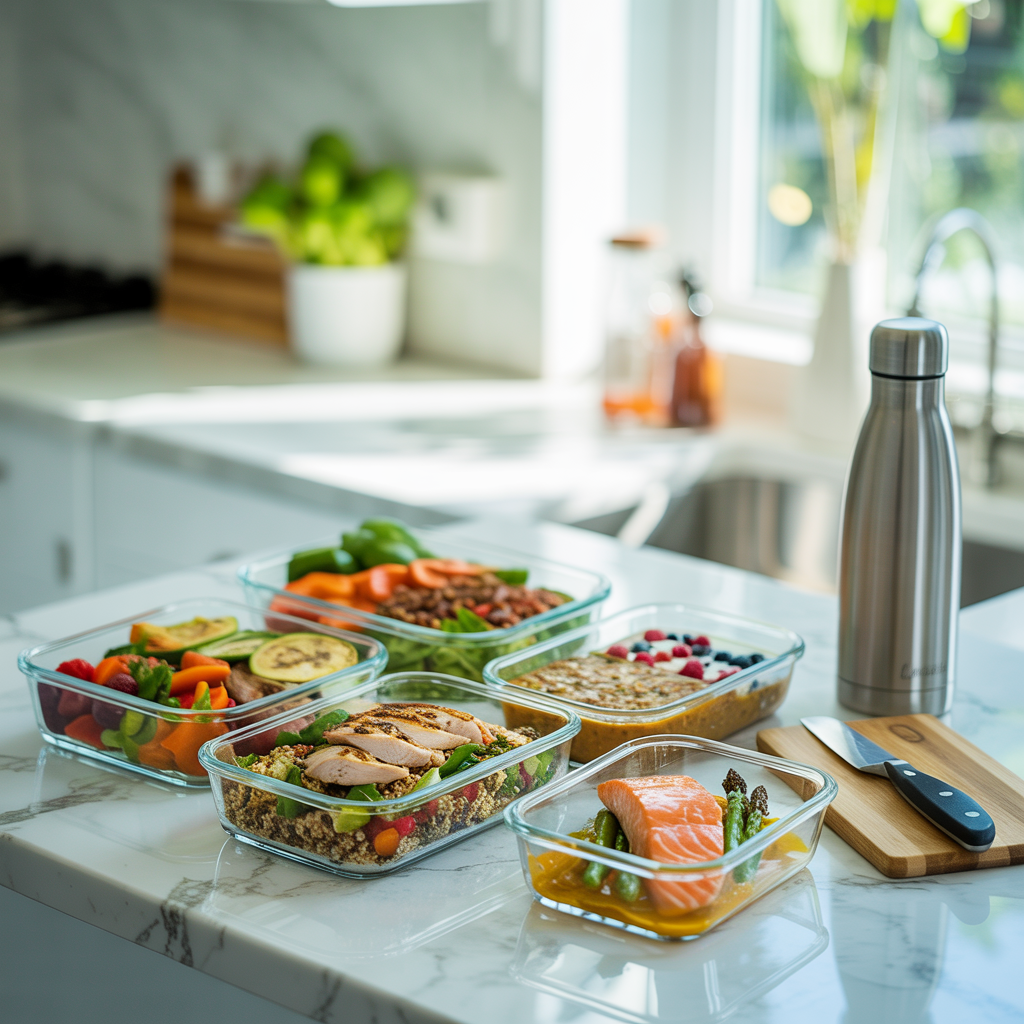
Additionally, airtight containers enable space-efficient storage, clear inventory visibility, and portion-controlled meal prep.
Frequently Asked Taco Tips
You’ve got taco salad on the brain, and now it’s time to tackle some common questions that’ll take your dish to the next level.
For instance, can you substitute ground turkey for beef, and what’s the prep time looking like?
Additionally, how long can you refrigerate your taco salad before serving?
Substitute Ground Turkey Instead
When seeking a healthier alternative to traditional ground beef in your taco salad, consider substituting with ground turkey – a savvy choice that not only slashes calories and fat but also packs a nutritional punch.
You’ll reduce your calorie intake by 120 calories per 4oz serving, and fat content drops by 14g.
Ground turkey also boasts a higher protein-to-fat ratio, supporting muscle maintenance and weight management goals.
To adapt the flavor, use 25-30% more taco seasoning and add a squeeze of lime juice to brighten the dish.
Don’t forget to incorporate smoked paprika and tomato paste for added depth.
With these tweaks, you’ll be enjoying a healthier, flavorful taco salad in no time!
0 Minutes Prep Time
Most taco salad recipes claim to be quick and easy, but just how much time can you expect to spend in the kitchen?
On average, you’ll spend between 10-15 minutes prepping, with total active kitchen time averaging 25-35 minutes.
However, this time can vary greatly depending on your skills and the ingredients you use.
For example, using commercial pre-seasoned beef can save you 3-5 minutes, while chopping fresh vegetables can add 15 minutes or more to your prep time.
Refrigerate up to 2 Days
Store your taco salad in the refrigerator for up to two days, but be aware that its quality will start to decline after 48 hours.
Since ground beef is a perishable protein, it’s best to consume it within two days for maximum food safety.
When refrigerating, use airtight containers to prevent cross-contamination and odor transfer.
Keep dressing and sauces separate from dry ingredients to maintain texture.
Monitor your salad for spoilage indicators like off-odors, visible mold, slimy textures, discoloration, or sour tastes.
If you notice any of these signs, discard the salad immediately.
Enjoy Your Delicious Homemade !
Create your ultimate taco salad experience by combining the core ingredients in a way that suits your taste preferences!
You’ve worked hard to prepare this delicious meal, and now it’s time to enjoy it.
Take a bite and savor the flavors of seasoned ground beef, fresh vegetables, and crunchy tortilla chips.
You can customize your salad to your liking with various toppings and dressings.
With approximately 350-450 calories and 25g+ of protein per serving, you can feel good about what you’re putting in your body.
Frequently Asked Questions
Can I Use Lean Ground Beef Instead of Regular Ground Beef?
You can use lean ground beef instead of regular, but be aware that it’ll retain more volume, may require added moisture, and have a drier texture, so adjust cooking time and add flavor enhancers to compensate for the differences.
How Long Does the Taco Salad Stay Fresh in the Fridge?
You typically have 2-5 days to enjoy your prepared salad in the fridge, depending on ingredients like avocado and dairy, before perishable parts like lettuce start to wilt and spoilage sets in.
Can I Add Other Toppings Like Diced Tomatoes or Shredded Cheese?
You can definitely customize your salad with toppings like diced tomatoes or shredded cheese, which add freshness and richness, respectively. Feel free to get creative and mix-and-match toppings to find your perfect combination!
Is It Possible to Make This Recipe in a Slow Cooker?
You can make many recipes in a slow cooker, and it’s a great way to cook ground beef, as it allows for tenderization and flavor melding. Yes, you can definitely make this recipe in a slow cooker, just brown the beef first for added flavor.
Can I Use Store-Bought Taco Seasoning Instead of Homemade?
You can use store-bought taco seasoning, but you’ll sacrifice flavor intensity, customization, and quality, and may ingest unwanted additives. Homemade blends offer bolder flavor, adaptability, and cost savings, making them a better choice for frequent users.
References
- https://www.wholesomeyum.com/recipes/taco-salad/
- https://www.spendwithpennies.com/easy-taco-salad/
- https://www.saltandlavender.com/easy-beef-taco-salad/
- https://thebalancednutritionist.com/ground-beef-salad/
- https://www.bettycrocker.com/recipes/crunchy-potluck-taco-salad/b55fbc95-84d6-4a7a-963d-94375a439b8e
- https://www.youtube.com/watch?v=S8VMZROrzIs
- https://thesavvyspoon.com/2025/01/23/crunchy-loaded-taco-salad-recipe/
- https://www.foodfanatic.com/recipes/loaded-crunchy-taco-salad-recipe/
- https://www.bitchinfrommelanieskitchen.com/2022/04/-the-history-of-taco-salad-the-doritos-taco-salad-.html
- https://nuestrostories.com/2024/01/the-controversial-history-of-taco-bowls/
- https://en.wikipedia.org/wiki/Taco_salad
- https://thetacotrail.com/2016/05/06/the-taco-salad-will-make-america-great-again-a-brief-history-sad/
- https://www.health.com/nutrition/cilantro-benefits
- https://www.webmd.com/diet/health-benefits-cilantro
- https://www.medicalnewstoday.com/articles/277627
- https://aggie-horticulture.tamu.edu/food-technology/nutrition/parsley-and-cilantro/
- https://draxe.com/nutrition/cilantro-benefits/
- https://www.primaverakitchen.com/ground-beef-taco-salad/
- https://hestanculinary.com/blogs/news/large-skillet-vs-pan-differences-and-best-uses
- https://www.thespruceeats.com/best-skillets-to-buy-4138192