You can elevate your lunch game by crafting a tuna salad that boasts a rich flavor profile, whether you prefer a classic mayo-based dressing or a lighter vinaigrette option. Opt for sushi-grade tuna like Ahi or Yellowfin, and don’t forget to add a burst of freshness with chopped parsley and a squeeze of lemon juice. With a sharp knife and some basic prep, you’ll be on your way to a delicious and healthy meal in no time, and discover even more tips and tricks to perfect your dish.
##
You’re about to dive into the world of tuna salad, and it’s time to explore the classic mayo-based version.
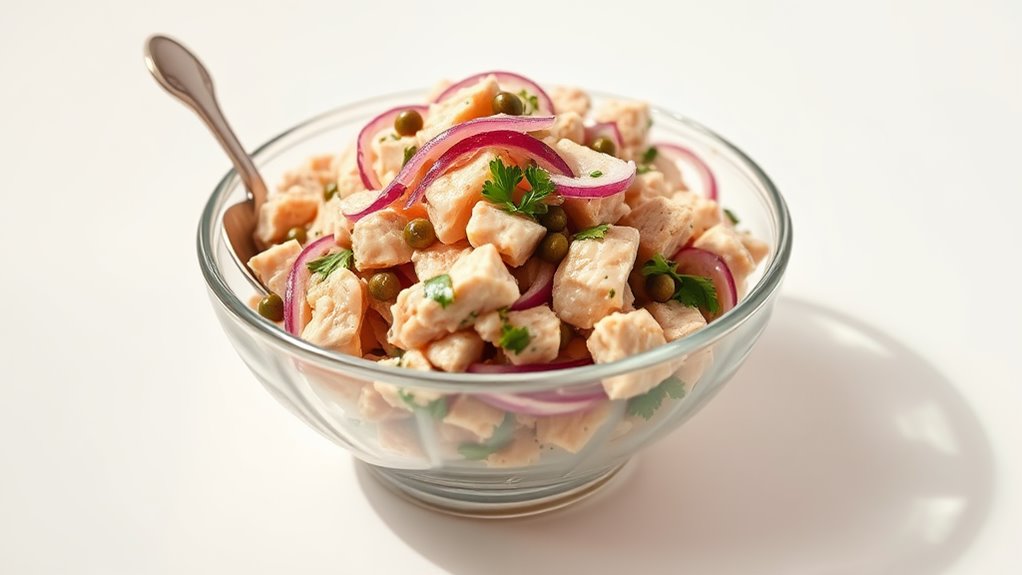
You’ll typically find canned tuna, mayonnaise, diced celery, and chopped onion in this mix.
You can enhance the flavor with lemon juice, Dijon mustard, and seasonings like salt and pepper.
Sweet pickle relish adds sweetness and tang, while fresh herbs like parsley or dill add freshness.
You can serve it in sandwiches, on crackers, or in lettuce cups, making it a versatile option.
Tuna salad can be prepared in just 15 minutes, making it a great choice for a quick and easy meal.
The key to a great tuna salad is using high-quality ingredients and preparing them correctly, which is why draining the tuna is an essential step to prevent a watery consistency.
Fresh Tuna Introduction
Fresh tuna belongs to the mackerel family, with about 15-20 distinct species globally, and it’s the most frequently consumed type of tuna.
You’ll find several species sold fresh, including Albacore, Yellowfin, Bigeye, and Bluefin.
These species inhabit all major oceans, with specific distributions varying.
When buying fresh tuna, you can expect to find it in most supermarkets, especially in countries like Japan, the USA, and Spain.
You can purchase it year-round, but availability may be seasonal for certain species.
Fresh tuna is typically characterized by its meaty texture and is often served in high-end restaurants due to its unique flavor profile.
Tuna is rich in omega-3 fatty acids, which contribute to its popularity in many cuisines around the world.
The Ahi tuna type, which includes Yellowfin species, is commonly used in various dishes due to its rich flavor profile and reddish color.
Most tuna species are managed by RFMOs that oversee the conservation and management of tuna populations worldwide to ensure sustainability.
Fresh Tuna Flavor
What sets fresh tuna apart from other fish is its rich, meaty flavor profile, which tends toward sweet and saline notes.
Fresh tuna stands out with its rich, meaty flavor profile and sweet saline notes.
You’ll experience a dense, firm texture that’s smooth to the bite.
Key characteristics of fresh tuna flavor include:
- Rich, meaty flavor
- Sweet and saline notes
- Dense, firm texture
- Clean, less “fishy” taste.
Fresh tuna is an excellent source of protein and other essential nutrients, making it a popular choice for health-conscious individuals.
As you savor fresh tuna, you’ll notice its unique taste profile, which is enhanced by its fat content and the presence of umami. The main types of tuna, including Skipjack, are often used in various dishes due to their distinct flavor profiles and firm textures.
The high fat content in certain tuna species contributes to a richer and more intense flavor experience.
Ancient Japanese Influence
As tuna consumption dates back to the Jomon period, possibly over 10,000 years ago, it’s clear that ancient Japan played a significant role in shaping the country’s affinity for this fish.
You’ll find that skipjack tuna was a staple, easily preserved when dried.
The Japanese also created *katsuobushi*, a dried and smoked tuna product used in soup stocks.
You can see that ancient Japan’s influence on tuna consumption is significant, with tuna bones dating back around 5,000 years found in Aomori prefecture.
This long history of tuna consumption has had a lasting impact on Japanese cuisine, with the use of various cuts of tuna being a key aspect of this culinary tradition. The bluefin tuna is particularly prized in Japan for its rich flavor and firm texture, which is often used in high-end sushi and sashimi dishes. The process of making katsuobushi involves smoking over straw or wood, which helps to preserve the fish and give it a unique flavor.
Tuna was initially unpopular in Japan due to spoilage, but the Edo period marked a turning point with soy sauce preservation and a rise in sushi restaurants.
Fresh Tuna Needs
You’re about to create a delicious tuna salad, and it starts with choosing the right fresh tuna.
You’ll want to opt for sushi-grade or sashimi-grade tuna, such as Ahi, Yellowfin, or Albacore, and ask your fishmonger for 1-inch thick filets.
Consider wild-caught Yellowfin or Albacore when available, and be mindful of mercury levels and freshness indicators.
For a protein-packed option, look for fresh tuna steaks that weigh about 1 pound.
Choose tuna packed in water to control fat content and enhance flavor control.
The Full Ingredient List
For the fresh tuna salad recipe, you’ll need the following essential ingredients:
- Fresh tuna (Ahi, Yellowfin, or Albacore) – approximately 1 pound, cut into 1-inch thick filets or steaks
- Olive oil for cooking and dressing
- Sea salt for seasoning
- Ground black pepper for seasoning
When selecting tuna, opt for solid white tuna from albacore for larger pieces and higher quality.
Optional ingredients for added flavor and texture:
- Celery
- Red onion
- Scallions
- Radishes
- Cucumber
- Capers
- Dill pickles or sweet relish
- Kalamata olives
- Fresh parsley
- Fresh dill
- Fresh mint
- Chives
- Hard-boiled eggs
- Pine nuts
- Avocado
- Diced apples
For the dressing, you can choose between a classic mayo dressing or a lighter vinaigrette option:
Classic Mayo Dressing:
- Mayonnaise (Hellmann’s or Duke’s suggested) or Greek Yogurt substitute
- Fresh lemon juice
- Dijon mustard
- Prepared white horseradish
- Worcestershire sauce (or soy sauce)
- Grated or finely minced fresh garlic
- Salt and black pepper to taste
Vinaigrette Dressing:
- Extra virgin olive oil
- Lemon juice, lime juice, white wine vinegar, red wine vinegar, or rice vinegar
- Soy sauce, grated ginger, wasabi paste, Dijon mustard, sumac, black olive tapenade, or fresh herbs (basil, parsley, mint, dill, cilantro)
- Garlic (grated or minced)
- Kosher salt, black pepper, and optional red pepper flakes
Sharp Knife
A sharp knife isn’t just a luxury, it’s a necessity in the kitchen.
You’ll be amazed at how much easier food prep becomes with a sharp blade.
It’s not just about speed and efficiency, though those are certainly benefits.
A sharp knife is also safer to use, reducing the risk of accidents and injuries.
- You’ll exert less pressure, reducing fatigue and strain on your hands and wrists.
- Your cuts will be precise and uniform, making cooking and presentation a breeze.
- You’ll preserve the texture and flavor of your ingredients, ensuring the best possible outcome.
- Food prep will become a more enjoyable experience, allowing you to focus on the creative aspects of cooking.
With a sharp knife, you’ll minimize blade slips and other kitchen accidents, making cooking a safer experience.
Moreover, sharp knives behave predictably during cuts, reducing the risk of losing control and causing injury, which enhances overall kitchen safety through reliable performance.
Sharp knives also boost efficiency through faster and easier food preparation, allowing you to complete prep work quickly and move on to the creative aspects of cooking.
Tuna Prep Begins
You’re now ready to begin preparing your tuna for the salad.
Chop the onion finely, as it’ll add a pungent flavor to your dish, and have a mixing bowl ready to combine all the ingredients.
You can choose to use seared tuna for a smoky flavor or stick to canned tuna, opting for chunk light for a more affordable option, and don’t forget to add some fresh parsley for a burst of freshness.
Select sustainable tuna using a “know before you buy” approach to ensure you’re getting a dolphin-safe option, ideal for this recipe.
When choosing canned tuna, consider white tuna for a milder flavor and firmer texture, perfect for this classic salad recipe.
Canned tuna provides about 20 grams protein per 3 ounces, making it a nutritious addition to your salad.
1. Chop the Onion Finely
Jump into the prep work by tackling the onion, an essential component of your tuna salad. Choose a red onion for its color, crunch, and mild flavor. Since you’ll be using Greek yogurt as a mayonnaise substitute, adding probiotics will provide an extra health benefit to your salad.
To chop the onion finely, trim the top and halve it lengthwise, then make vertical cuts towards the root. Keep the root end intact to hold the layers together.
Make horizontal cuts, if desired, and slice crosswise to create fine dice.
Aim for 1/4 inch or less for a fine chop. Use a sharp knife to release fewer irritating compounds and work quickly to minimize tears.
You’ll end up with a finely chopped onion that won’t overpower your tuna salad.
Purple onion can be substituted with white or yellow onion if needed, providing a similar texture and crunch to the salad.
Soak the minced red onion in cold water for 5 minutes to reduce its pungency before draining and drying it on paper towels.
2. Mixing Bowl Required
Select a mixing bowl that’s large enough to accommodate all the ingredients and allow for thorough mixing without spilling. Medium-sized bowls are commonly suggested for standard recipes using 2-4 cans of tuna, while larger bowls are necessary for bigger batches or when adding many bulky ingredients. You’ll want to guarantee enough room to “toss” or “stir” ingredients thoroughly without them falling out. Once you’ve chosen your bowl, it’s time to drain the canned tuna. You can do this by pressing the detached can lid firmly against the tuna or by using a fine-mesh strainer. Squeeze or press the tuna to remove as much liquid as possible, and then transfer it to your mixing bowl. If the tuna is cooked in the can, you won’t need to drain it, as it will retain its natural juices and omega-3 fats. For this recipe, we utilized two 4-pound cans of solid white Albacore packed in water, which resulted in an ample quantity for snacking.
3. Seared Tuna
ingredients_visual: Ahi tuna steak (at least 1 inch thick), paper towels, salt, pepper, sesame seeds (optional), soy sauce (optional), sesame oil (optional), ginger (optional), garlic (optional), avocado oil (or other high smoke point oil), heavy-bottomed skillet (cast iron or quality nonstick), tongs, sharp knife.
cooking_action: A hot skillet with sizzling oil, a tuna steak being carefully placed in the hot oil, a spatula pressing down gently on the tuna for good contact, a tuna steak searing in the skillet for 45-90 seconds per side, tongs briefly searing the edges.
final_dish: Thinly sliced seared tuna steak, with a crispy exterior and a rare interior, served with a side of your choice.
The recipe completes from start to finish in five minutes or less, making it an ideal option for a quick and impressive meal.
4. Add Fresh Parsley
Start by adding freshness to your tuna salad with a handful of fragrant, vibrant green parsley leaves.
Remove the leaves from their stems, wash them under cold water, and dry them thoroughly.
Then, gather the leaves into a ball and chop them finely with a sharp knife using a rocking motion.
This will guarantee even distribution in the salad.
Parsley adds a light, herby flavor and a mild, slightly peppery taste, cutting through the richness of tuna and mayonnaise.
It also pairs well with other fresh herbs like dill or mint.
Typically, you’ll add 1-3 tablespoons of finely chopped parsley towards the end of mixing, complementing ingredients like lemon, celery, and onion.
Tuna Salad Complete
Tuna Salad Core Components Visual: A can of chunk or solid white albacore tuna in water, a jar of mayonnaise, a stalk of celery.
A red onion, a lemon, a bottle of Dijon mustard.
A pickle jar, salt, black pepper, and fresh herbs like parsley or dill.
Fresh Lemon Juice
When making tuna salad, you’re likely to reach for fresh lemon juice to add a burst of citrus flavor and brightness.
But did you know that using fresh lemon juice can also bring benefits like neutralizing fishy odors and tenderizing the meat?
Lemon Zest
Fresh from the outermost layer of lemon peel, lemon zest bursts with concentrated natural oils, packing a punch of bright, aromatic flavor that’s less acidic than its juice counterpart.
When you zest, you’re capturing the essence of citrus, perfect for adding depth to your tuna salad without adding liquid.
To get the most out of your zest, wash and dry your lemons thoroughly, then use a microplane or zester to remove only the colored, flavorful layer.
Avoid the bitter white pith underneath.
You can use your zest in a variety of ways, from baking to marinades, and even as a garnish.
With its concentrated flavor, a little zest goes a long way, so start with a small amount and taste as you go.
Juice Benefits
What’s the real deal with lemon juice in your tuna salad?
You’re getting a wealth of benefits!
Lemon juice is packed with Vitamin C, an essential antioxidant that protects cells from damage.
It’s also a rich source of citric acid, potassium, and B vitamins, making it a nutritious addition to your tuna salad.
The antioxidants in lemon juice may help reduce the risk of chronic diseases like cardiovascular disease and diabetes.
Additionally, the citric acid can aid digestion by stimulating stomach acid levels and improving iron absorption.
Plus, it can help prevent kidney stones and contribute to skin health and immune function.
With all these benefits, it’s no wonder lemon juice is a great addition to your tuna salad!
Fresh Squeeze
You’re about to unlock the full potential of your tuna salad by incorporating the star of the show: fresh lemon juice.
This game-changer introduces brightness and acidity, balancing the richness of mayonnaise and tuna.
The acidity cuts through fatty components, creating contrast and adding a tangy, vibrant element to the flavor profile.
When you add lemon juice first, the tuna absorbs its flavor primarily, complementing other ingredients like celery, onion, and herbs.
Freshly squeezed lemon juice contributes freshness, acts as a natural preservative, and helps tame the “fishiness” of canned tuna.
Add it to taste, adjusting the tanginess to your liking, and don’t be afraid to combine it with other ingredients for a truly unforgettable tuna salad.
Overmixing Ruins Texture
When combining tuna with other ingredients, it’s essential to mix with a gentle touch, as overmixing can have devastating consequences for the overall texture.
You’ll end up with a mushy, unappetizing salad that’s more like a paste than a chunky mix.
Mushy, unappetizing salads await when tuna is overmixed, resulting in a paste-like consistency instead of a desirable chunky mix.
- Tuna flakes break down into shreds, losing their distinct chunks.
- The salad becomes a heavy, gloopy mess, with excess liquid making the dressing watery.
- Ingredients like avocado get mashed, adding to the mush.
- The entire salad takes on a bland, soggy quality, with flavors diluted by excess moisture.
On Toasted Bread
Now that you’ve mastered the art of mixing tuna salad without overdoing it, it’s time to think about how to serve it.
You’ll want to choose a sturdy bread that can hold the filling effectively, like sourdough, French, or Italian bread.
Whole wheat, rye, or multigrain options offer nutritious alternatives.
Toasting the bread is a must, whether you use a toaster, broiler, or skillet, as it prevents sogginess and adds a delightful crunch.
You can serve the tuna salad open-faced on a single slice or between two slices of toasted bread.
Add some flair with toppings like arugula, tomato, or mashed avocado, and don’t forget to think about a tuna melt with melted cheese for a deluxe twist.
Airtight Container
Proper storage is essential to maintaining the freshness and safety of your tuna salad.
You’ll want to store it in an airtight container to prevent contamination from bacteria and outside odors.
Glass or high-quality, BPA-free plastic containers with silicone or rubber gaskets on lids are suitable options.
Shallow containers help the tuna salad cool quickly in the refrigerator.
When storing, place the container in the coldest part of the refrigerator, usually the back, and label it with the preparation date.
Pressing plastic wrap onto the salad surface before sealing can help remove air pockets.
Tuna FAQs Start
You might be wondering if you can substitute tuna with salmon in your salad, and the answer is yes.
If you’re short on time, you’ll be happy to know that preparing a tuna salad takes only about ten minutes.
Plus, you can make it ahead of time and store it in the fridge for up to 24 hours.
Substitute With Salmon
If you’re looking to mix things up in your tuna salad, consider substituting with salmon – it’s a great way to add more omega-3 fatty acids to your diet.
Salmon offers nearly five times more omega-3s per 100g serving than tuna, making it an excellent choice for those looking to boost their intake.
You’ll also get more calories and fat, but substantially more Vitamin D, Vitamin B12, and folate.
The flavor and texture will differ too – salmon has a richer, oilier taste and a moister texture.
Plus, it generally has lower mercury levels than tuna, making it a safer choice.
Ten Minutes Preparation
Getting started with tuna salad is a breeze, thanks to the convenience of canned tuna. You’ll be ready to mix and serve in just 10-15 minutes.
Since canned tuna requires no cooking, you can skip that step and dive right in.
Simply drain the liquid (if needed), flake the tuna with a fork, and mix with your desired ingredients.
The process involves minimal steps: drain, add ingredients, mix.
With canned tuna, you’ve got a quick, convenient, and versatile protein source at your fingertips.
Yes, 24 Hours
Twenty-four hours is a generous window for making tuna salad ahead, and it’s a common practice among many home cooks and professional chefs.
You can prepare your tuna salad a day in advance, allowing the flavors to meld together and enhancing the taste.
Some recipes even suggest making it at least 12 hours ahead or overnight for better flavor.
When making tuna salad ahead, consider adding the dressing just before serving to prevent pasta from absorbing too much.
You can also prepare components like the dressing or chopped vegetables a day or two in advance and store them separately.
Just remember to store your tuna salad in an airtight container in the coldest part of the fridge to maintain freshness.
Enjoy Your Delicious Homemade !
You’ve crafted the perfect tuna salad, and now it’s time to enjoy it!
Serve it on toasted bread with lettuce and tomato for a classic sandwich, or wrap it in tortillas or pita bread for a twist.
You can also scoop it onto crackers or chips for a quick snack or serve it on a bed of mixed greens.
For a creative presentation, stuff it into avocado halves or hollowed-out tomatoes.
Don’t be afraid to get creative with add-ins like olives, jalapeño, or chopped nuts to give your tuna salad a unique flavor.
Whatever way you choose, you’ll be delighted with your delicious homemade tuna salad!
Frequently Asked Questions
Can I Use Canned Tuna Instead of Fresh Tuna?
You’re wondering if you can use canned tuna instead of fresh tuna, and the answer is yes! Canned tuna is a convenient, cost-effective alternative that offers a similar nutritional profile, with some differences in texture and flavor.
How Long Does Homemade Tuna Salad Keep in the Fridge?
You’re wondering how long your homemade tuna salad will keep in the fridge? Generally, it’s safe to store it for 3 to 5 days when refrigerated properly, but it’s best to consume it within 3 to 4 days for maximum freshness.
Is Tuna Salad Suitable for a Gluten-Free Diet?
You’re wondering if your meal is gluten-free; the good news is that plain tuna, veggies, and herbs are naturally gluten-free, but be cautious of added broths, soy sauce, or thickeners in canned tuna and check mayonnaise labels for gluten-free status.
Can I Add Other Ingredients Like Onions or Capers to Tuna Salad?
You can definitely customize your tuna salad by adding ingredients like onions, capers, or other aromatics to give it a fresh flavor boost. Experiment with different combinations to find your perfect mix!
Is Tuna Salad Safe to Eat During Pregnancy?
You’re wondering if tuna is safe during pregnancy. Generally, you can eat low-mercury tuna in moderation; however, you should avoid high-mercury types and raw/undercooked tuna. Now, about that tuna salad…
References
- https://downshiftology.com/recipes/tuna-salad/
- https://www.onceuponachef.com/recipes/a-really-good-tuna-salad.html
- https://chickenofthesea.com/blog/tuna-salad-calories/
- https://www.webmd.com/diet/ss/slideshow-best-worst-salads
- https://www.themediterraneandish.com/mediterranean-tuna-salad/
- https://www.budgetbytes.com/mediterranean-tuna-salad/
- https://www.liveeachday.com/healthy-tuna-salad-recipe-without-mayonnaise/
- https://twocloveskitchen.com/healthy-tuna-salad/
- https://www.mooijer.nl/en/knowledge-base/responsible-good-quality-tuna/
- https://lautbiruseafood.com/about-tuna-and-its-varieties/
- https://fultonfishmarket.com/blogs/articles/essential-guide-to-tuna
- https://elisetriestocook.com/the-ultimate-guide-to-buying-ahi-tuna/
- https://www.pewtrusts.org/en/research-and-analysis/fact-sheets/2012/05/02/maps-global-tuna-management
- https://planettuna.com/en/useful-tips-for-buying-tuna-ii-a-short-guide-to-buying-fresh-or-frozen-tuna/
- https://sushiuniversity.jp/basicknowledge/tuna
- https://wildplanetfoods.com/blogs/blog/what-to-know-about-various-tuna-species
- https://www.williams-sonoma.com/recipe/tip/all-about-tuna.html
- https://www.cbi.eu/market-information/fish-seafood/fresh-tuna/market-potential
- https://www.kenresearch.com/industry-reports/global-tuna-fish-market
- https://chickenofthesea.com/blog/types-of-tuna/